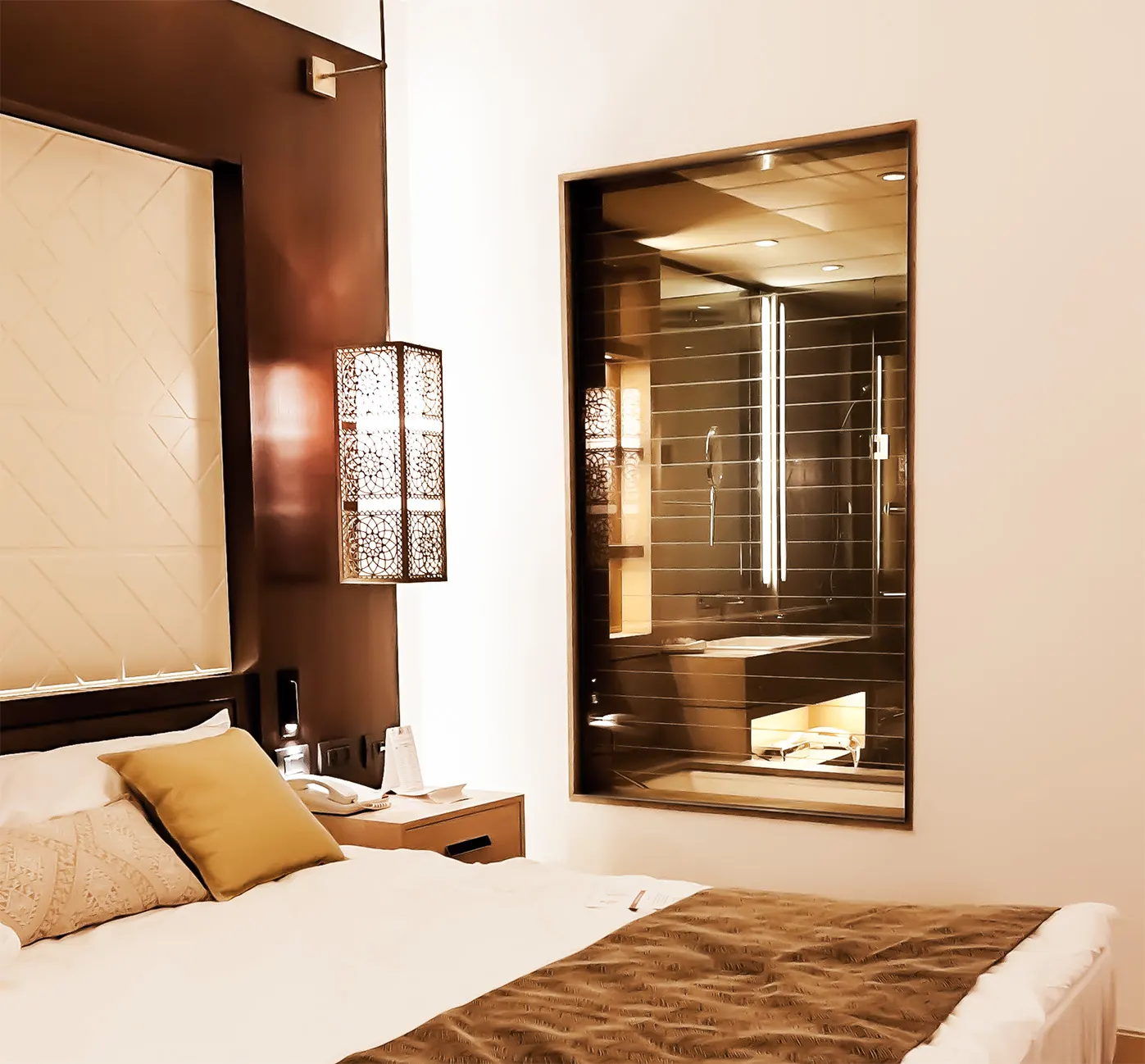
Switchable glass — also known as smart glass — changes between transparent and opaque at the touch of a button. In a fraction of a second, a clear glass wall becomes an opaque surface that blocks the view, and back again. This creates privacy exactly when it is needed, without curtains, blinds or permanent frosting.
For architects and interior designers, this opens up new possibilities: rooms remain open and transparent but can be screened off immediately when needed. In meeting rooms, medical practices, hotels and bathrooms, switchable glass combines transparency with discretion — as a function that adapts to the moment.
How switchable glass works
PDLC (polymer dispersed liquid crystal) is used for switchable privacy. Microscopic liquid crystals are embedded in a film between two glass panes. Without power, these crystals are disordered, scatter the light and make the glass opaque so that it blocks the view. As soon as electrical voltage is applied, the crystals align, the light passes straight through — and the glass becomes transparent in less than a second.
The change is made via a switch, remote control, app or sensors integrated into the building services. In the transparent state, PDLC needs power continuously.
Technical values at a glance
For orientation, typical values — they vary depending on manufacturer and build-up:
| Value | PDLC (privacy) | Electrochromic (façade) |
|---|---|---|
| Switching | transparent ↔ opaque | light ↔ tinted (infinitely dimmable) |
| Switching time | less than 1 second | several minutes (tinting) |
| Power requirement | continuous in the transparent state | mainly when switching |
| Operating voltage | low voltage via transformer | very low (e.g. < 5 V DC) |
| Light transmittance | high (clear) / scattering (opaque) | falls significantly with tinting |
| g value | for privacy, not solar control | falls significantly with tinting |
The decisive difference: PDLC switches instantly between clear and opaque and needs power for the transparent state — ideal for privacy indoors. Electrochromic (EC) glass tints slowly and infinitely variably, needs power mainly when switching and reduces the solar energy input — ideal for solar control and glare reduction in the façade. Depending on the goal, anyone who says “switchable glass” therefore means two very different products.
Clear or opaque — the safe default
With PDLC: opaque without power, transparent with power. Energy is therefore needed continuously for the transparent position. That may sound unusual at first, but it is ideal in practice: the protected, opaque state is the safe default — privacy is maintained in a power failure.
Switchable glass as safety glass
The PDLC film is laminated between two glass panes. The pane counts as laminated safety glass if the manufacturer declares it as such; it then retains fragments. For overhead, barrier and walk-on glazing this is not enough: the design rules and calculation methods of DIN 18008 assume laminated safety glass with a PVB interlayer. With an inserted switchable film, separate evidence is needed, such as a construction technique permit.
Privacy on demand
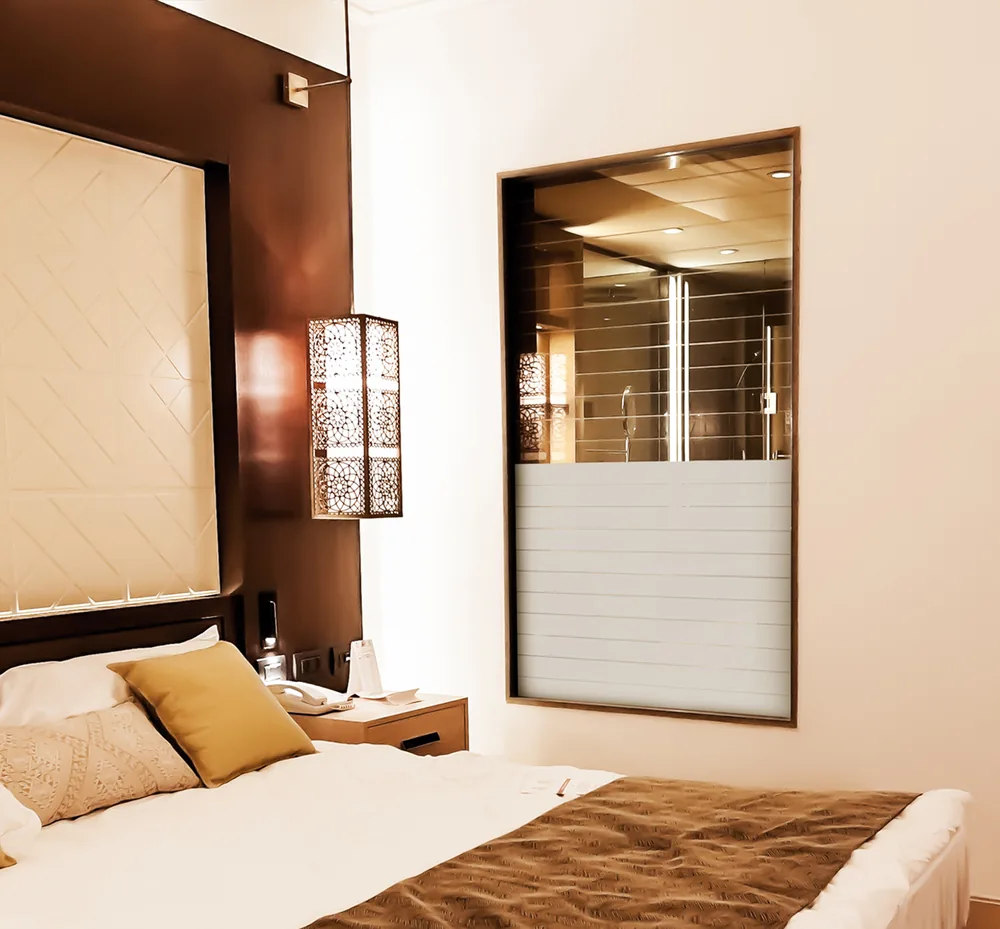
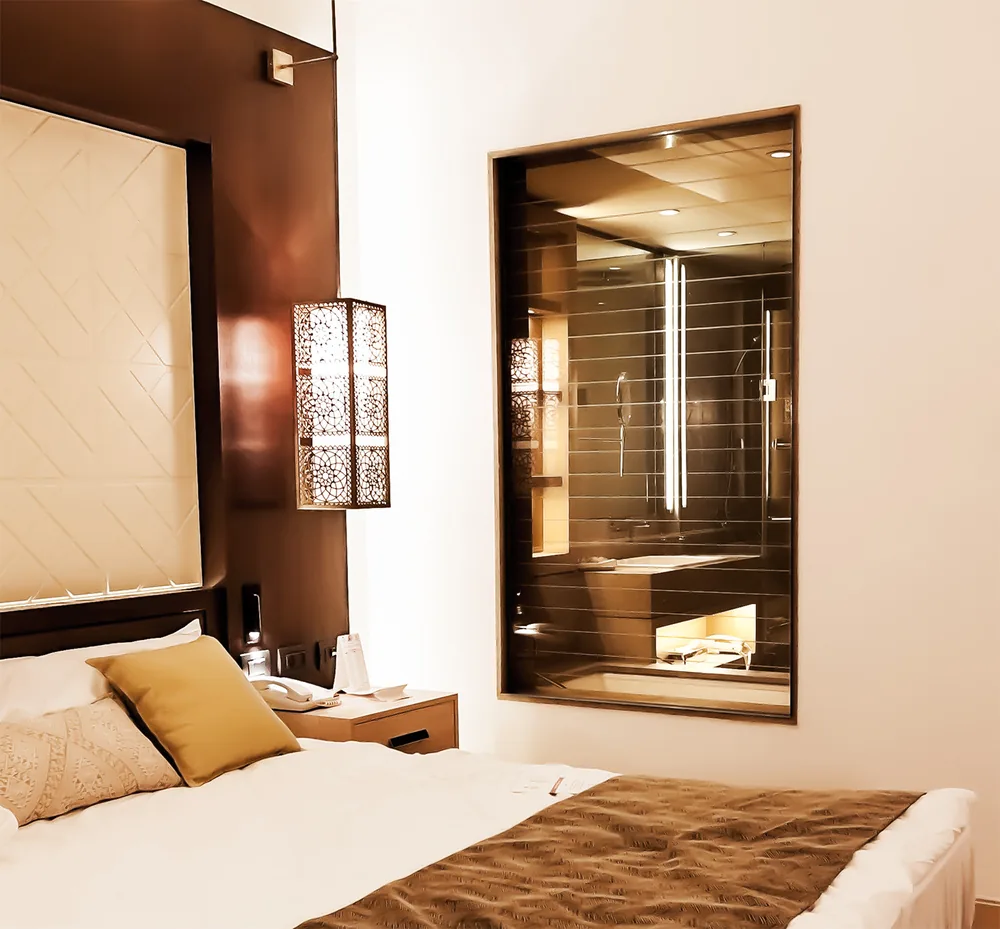
The most common use is switchable privacy. Meeting room glazing remains transparent and inviting but becomes opaque at the touch of a button for confidential conversations. In medical practices it protects privacy during treatment; in hotel bathrooms it separates bathroom and room flexibly. Important to know: in its opaque state the glass blocks the view but lets light through — it lets brightness in but hides outlines.
Switchable glass as a projection screen
In its opaque state, switchable glass acts like a projection screen. Images, presentations or videos can be projected onto the pane by rear projection, while in its transparent state it becomes a clear glass wall again. This dual function makes it particularly attractive in showrooms, reception areas, at trade fairs and in conference rooms — a glass wall that is partition, privacy screen and display at the same time.
Control and integration
Switchable glass can be controlled in many ways: via simple switches, radio remote controls, apps or the building management system. If large glass surfaces consist of several panes, these can be switched separately. Sensors and automation allow privacy to be linked to times of day, occupancy or presence and thus integrated into intelligent room concepts.
Applications
Switchable glass makes sense wherever transparency and discretion are needed alternately:
- Meeting rooms and offices: open and inviting, confidential when needed.
- Medical and treatment practices: privacy on demand.
- Hotels and bathrooms: flexible separation of bathroom and room.
- Shop windows and showrooms: privacy, presentation and projection.
- Partitions with privacy that adapts to the moment.
Advantages over conventional privacy screens
Compared with curtains, blinds or permanent frosting, switchable glass has several advantages: it is low-maintenance, with no moving fabric or slat parts, and it combines open transparency with instant screening. Where a conventional solution needs space and collects dust, the glass wall remains smooth and minimal — a gain in clarity and ease of care.
Durability
A clean edge seal and a professional electrical connection are decisive for durability. Stuck-on films are more sensitive to scratches than glass and can come off.
Costs and cost-effectiveness
Switchable glass is considerably more expensive than standard glazing, because the active film, the lamination and the electrical connection are complex.
The price rises with area, switching zones and the scope of control. Switchable glass becomes economical where it replaces several functions — privacy screen, partition and projection screen in one — and creates a prestigious, modern impression. Planning the wiring early saves effort later.
Saving energy with switchable glass
With controllable façade glass (electrochromic, SPD), there is an additional energy benefit: in summer the glass tints and reduces the solar energy input — this lowers the cooling load. In winter it stays clear and lets solar gains in. Properly integrated into building automation, dynamic glass thus helps reduce cooling and, in part, heating energy. PDLC privacy glass, on the other hand, does not primarily pursue an energy goal — its benefit lies in privacy, not solar control. Anyone expecting energy efficiency must therefore choose the right technology; this too is part of the neutral assessment.
Installation and electrical connection
Switchable glass is an electrical component and needs professional installation: a power supply unit or transformer (PDLC runs on low voltage), a concealed supply cable in the frame or reveal and connection by a qualified electrician. Switching can be via wall switch, radio, app, touch or sensors. When retrofitting film to existing glass, a clean, bubble-free substrate and professional contacting are important. So that the supply cable and connection point are not visible later, the electrical connection belongs in the design from the start — not only on site.
Technology variants at a glance
Switchable glass is an umbrella term for several technologies that differ in function and use:
| Technology | Switches | Control | Typical use |
|---|---|---|---|
| PDLC | transparent ↔ opaque | active (power) | privacy indoors |
| Electrochromic (EC) | light ↔ tinted | active (power) | solar control, glare reduction in the façade |
| SPD | light ↔ strongly tinted | active (power) | dynamic shading |
| Thermochromic / thermotropic | clear ↔ tinted/cloudy | passive (heat) | self-regulating solar control |
The distinction active vs. passive is important: PDLC, EC and SPD are switched (controlled by power), thermochromic, thermotropic and photochromic glass reacts to heat or light in a self-regulating way — without any active control. For classic privacy at the touch of a button, PDLC is the right solution. When it comes to controllable solar control and glare reduction in the façade, EC or SPD glass has the advantage; where automatic self-regulation is enough, the passive variants are an option. The choice follows the goal — and this is exactly where independent consulting comes in, because manufacturers each favour their own technology.
Switchable glass in the façade
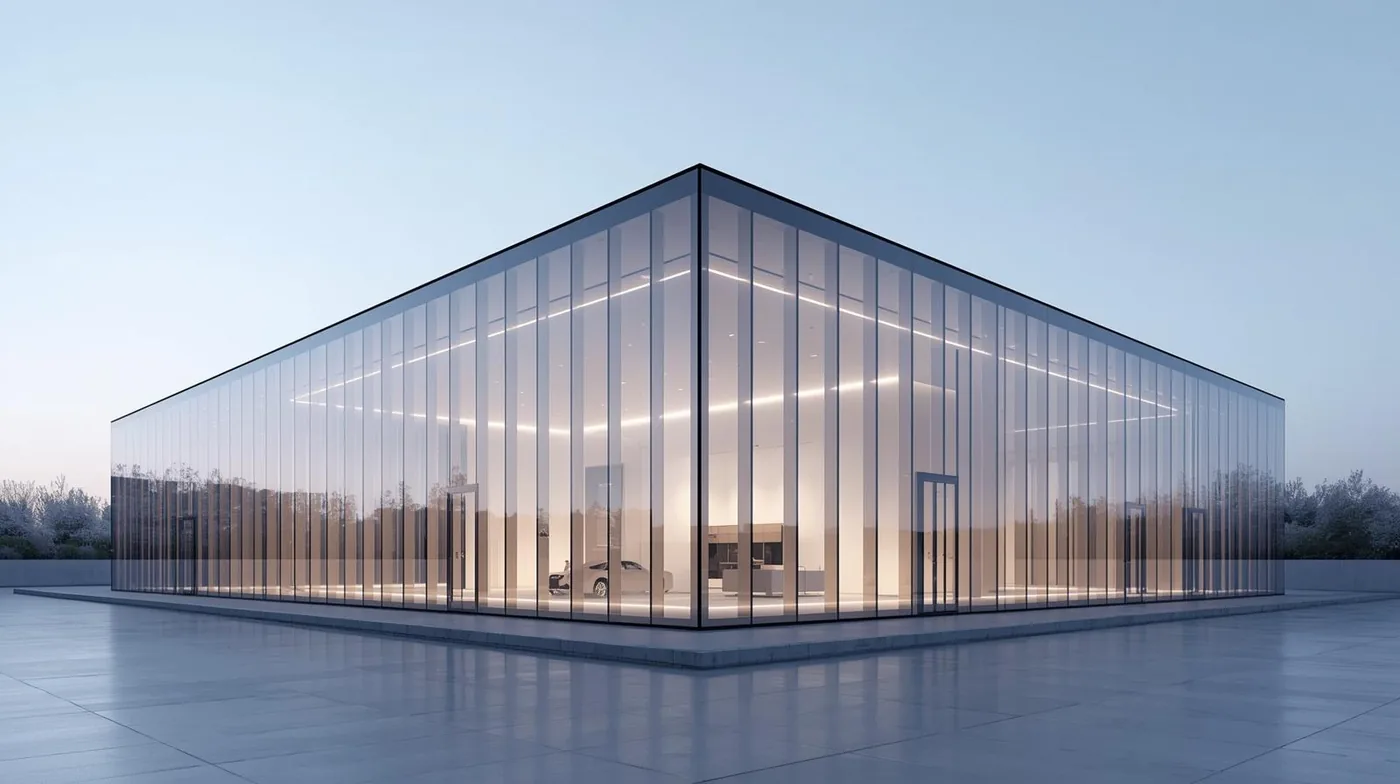
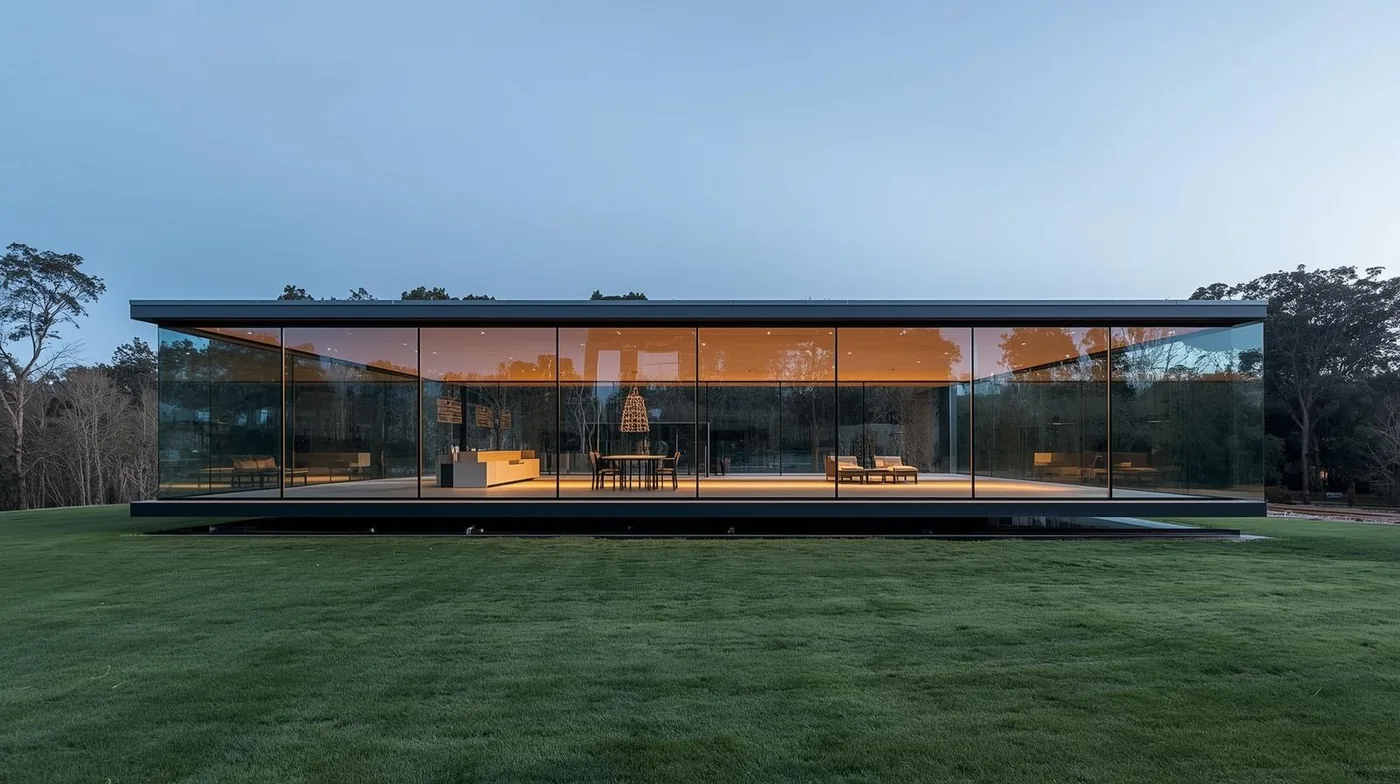
Besides interior fit-out, switchable glass is also used in façades — but usually with a different technology. While PDLC is mainly used for privacy indoors, electrochromic glass in the façade regulates light transmission and thus solar control and glare reduction: it tints at the touch of a button or automatically. Which technology fits depends on the goal — privacy indoors or solar control and glare reduction on the façade. We assess the methods for the task in question.
Discretion
Switchable glass scores particularly where discretion is needed. In medical and treatment rooms it protects patients’ privacy without curtains. In banks, law firms and consulting rooms it provides confidentiality on demand. Because no textile or moving parts are needed, the surface remains smooth.
Typical design errors
- Power supply and connection point planned too late, requiring rework.
- Expectation of complete darkening — opaque means it blocks the view, not the light.
- Retrofit film chosen where a durable, high-quality solution was required.
- Switching zones not thought through, so that large surfaces can only be switched as a whole.
Choosing the right switchable glass
The selection starts with the purpose: privacy only, projection as well, or safety-relevant glazing? This determines the build-up — laminated switchable glass, with separate evidence for barrier glazing. Then the switching zones and control are defined: uniform or in zones made of individual panes, manual or integrated into the building services. Finally, the electrical connection must be planned early so that the supply cable and connection remain invisible.
We bring these points together and coordinate technology, safety and control with each other instead of considering them one after the other.
Our role
We clarify purpose, safety requirements and control, design the glass build-up and switching zones and coordinate the electrical connection with the building services — independent of manufacturers and documented. Because manufacturers each favour their own technology, this neutral assessment of the available methods is particularly valuable. This turns a glass wall into an intelligent element that combines transparency and discretion at the touch of a button.