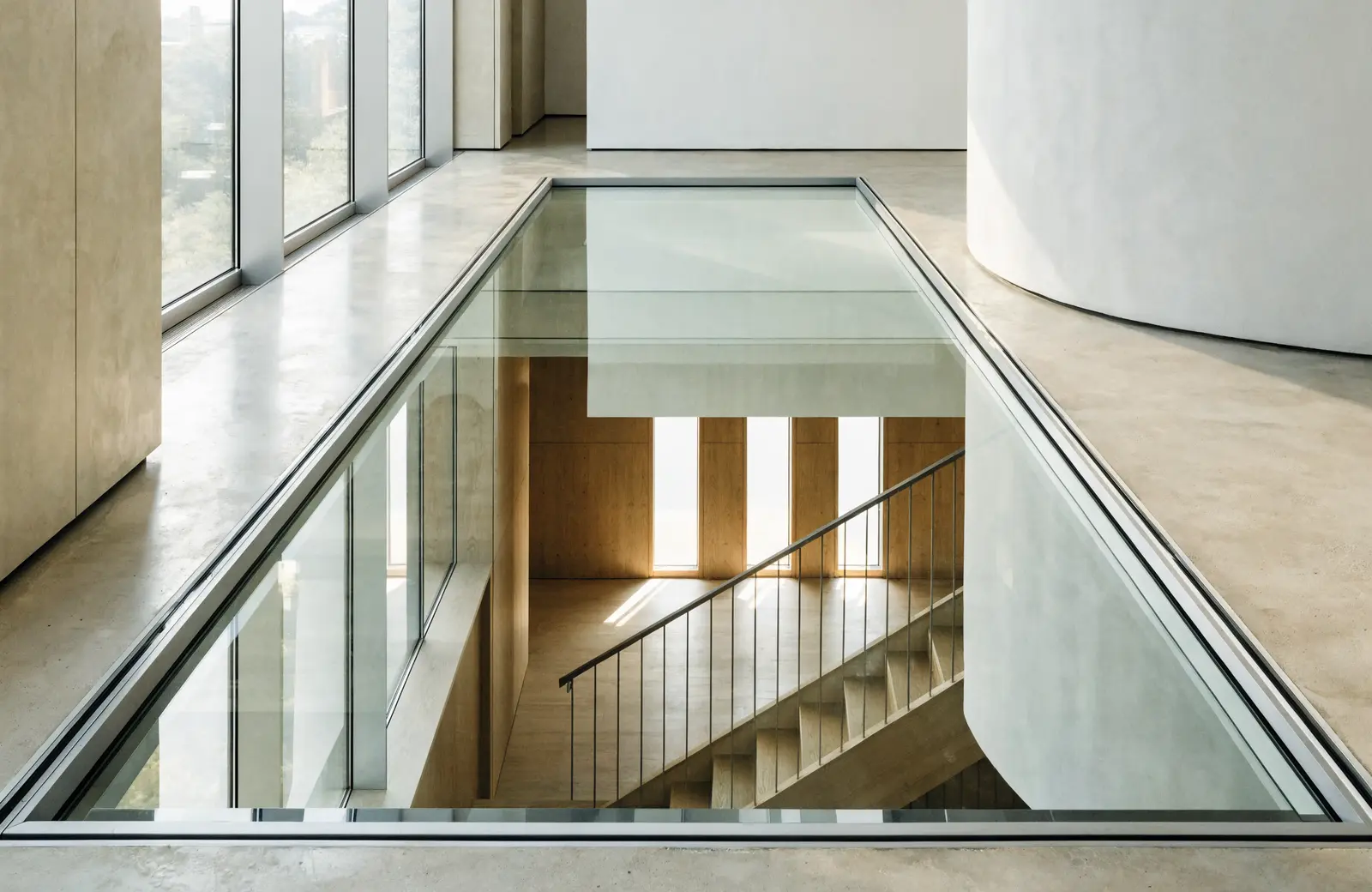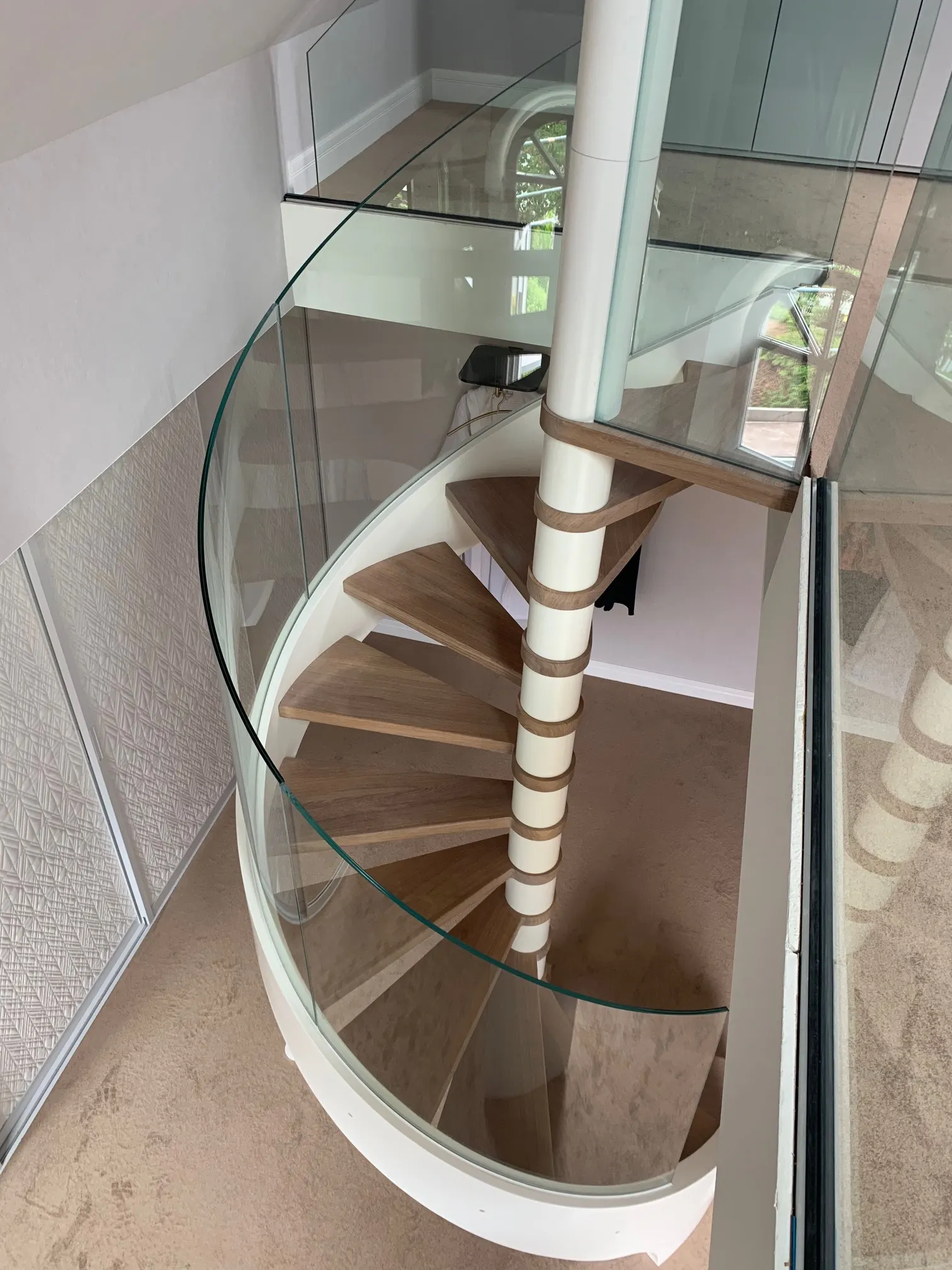
Curved glass opens up forms in architecture that flat glass cannot achieve: curved façades, round bay windows, flowing staircase glazing or cylindrical display cases. Where straight edges reach their limits, curved glass creates soft transitions and striking curves — with full transparency and with the same functions as flat glass.
At the same time, curved glass is a demanding special component. Shape, radius, glass build-up and tolerances must be defined early and coordinated with the manufacturer. For architects and planners, it is therefore a topic that belongs in the design, not in construction.
How glass is bent
The most common method is thermal bending. A flat glass pane is heated in a furnace over a mould to close to its softening point. Under its own weight — or with targeted assistance — it settles onto the mould and takes on the desired curvature. The glass is then cooled in a controlled manner.
Various products can be derived from this basic process: simple curved float glass, curved toughened glass, curved laminated safety glass and even curved insulating glass. Which route is chosen depends on the safety and functional requirements.
The bending processes compared
Not all curved glass is the same — depending on shape, radius and function, different processes come into question:
| Process | Principle | Suitability |
|---|---|---|
| Gravity bending | Glass sinks into the mould in the furnace under its own weight | also tight radii (from around 100 mm), standard case |
| Press bending | Glass is pressed between moulds | precise, tight radii, series |
| Bending during toughening | Bending and toughening in one step | curved toughened glass |
| Cold bending (bending on installation) | flat glass is only bent elastically during installation | large radii, without a furnace mould |
| Lamination bending | Bending in the laminate using a stiff interlayer | shallow curvatures, economical |
The two “cold” routes are particularly interesting: in cold bending, flat glass is forced into a slight curvature on the substructure and held there — this saves the expensive furnace mould and is suitable for large radii on façades. In lamination bending, the glass is held in shape in the laminated safety glass build-up by a stiff interlayer (such as ionoplast/SGP or EVA instead of the softer PVB). Both processes are often considerably cheaper than thermal bending — provided the curvature is shallow enough. This is exactly where an early, neutral check pays off: some “curved” façades can be solved cold instead of thermally, and therefore considerably more economically.
Cylindrical or spherical?
Curved glass is distinguished by its geometry:
- Cylindrically (single-axis) bent: the pane is curved around one axis, like a section of a cylinder. This is the most common and most economical form — for round façades, bay windows and display cases.
- Spherically (multi-axis) bent: the pane is curved in several directions, like a section of a sphere. This is more complex and is used for particularly sculptural components.
- Conically bent: the radius changes over the height of the pane — the shape opens out like a section of a cone. It is a special case for particular geometries and especially demanding to produce.
In addition, the bending direction relative to the glass edge is distinguished: along the long edge (LB) or along the short edge (CB) — this influences which formats and radii can be produced at all. Most projects work with cylindrical bends, because they best balance form, effort and cost.
Radius and glass thickness
The minimum possible radius is the key parameter. It depends on glass thickness, type of glass and format: thin panes can be bent more tightly, thick ones only with a larger radius — and above all, toughened glass cannot be bent as tightly as untreated float glass. For orientation:
| Type of glass | Minimum radius (guide value) |
|---|---|
| Float glass (untreated) | from approx. 50 mm (thin panes) |
| Laminated safety glass / laminated | larger, depending on build-up |
| Toughened glass | from approx. 200 mm |
Then there are the maximum dimensions and glass thicknesses, which depend on the manufacturer and the process. The specifically feasible radius is always a question of the chosen build-up, the format and the process, and is agreed with the manufacturer.
Safety: curved toughened and laminated safety glass
Curved glass can be toughened as toughened safety glass and laminated into laminated safety glass. This makes it suitable for curved balustrades, staircase parapets or floor-to-ceiling round glazing; laminated safety glass holds together when broken. Unlike flat glass, however, DIN 18008 does not cover horizontal, point-fixed or barrier curved glazing. These require a project-related construction technique permit (vBG) from the supreme building authority of the federal state.
Curved insulating glass
Curved glass is also available as multi-pane insulating glass, so it takes on thermal insulation and solar control functions. Production is demanding, however, because both panes must be bent to exactly the same shape to form a functioning edge seal. Tighter tolerances, higher costs and longer delivery times must be planned for accordingly — the effort pays off wherever curved façades also need to be of high energy quality.
Applications
Curved glass is found in very different building tasks:
- Curved façades and bay windows: striking, flowing building edges.
- Round glazing and display cases: museums, exhibitions, shopfitting.
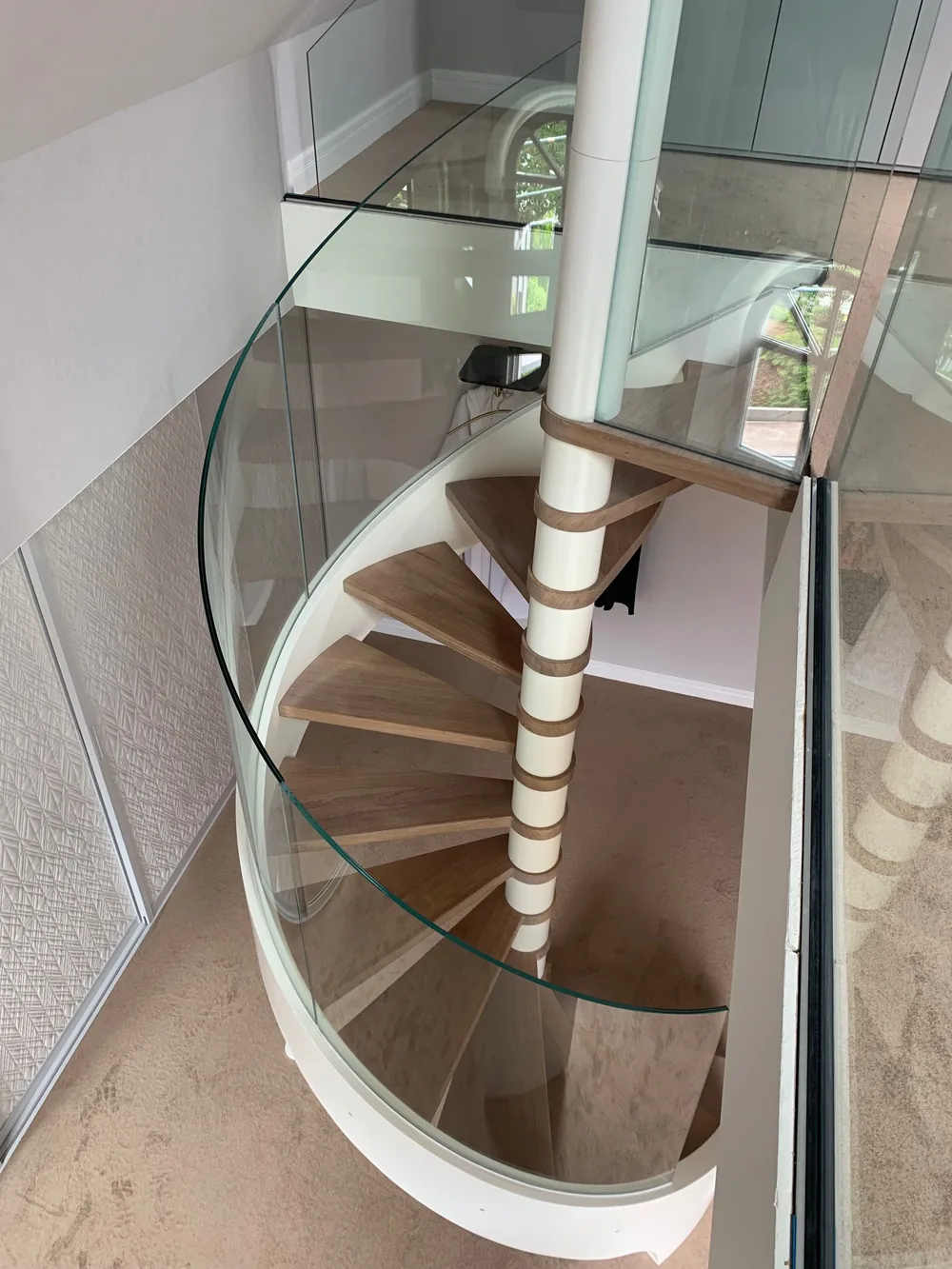
- Staircase and lift glazing: elegant, transparent circulation.
- Showers and interior fit-out: round showers and curved room dividers.
- Listed buildings: replacement of historic curved panes.
Curved glass in listed buildings
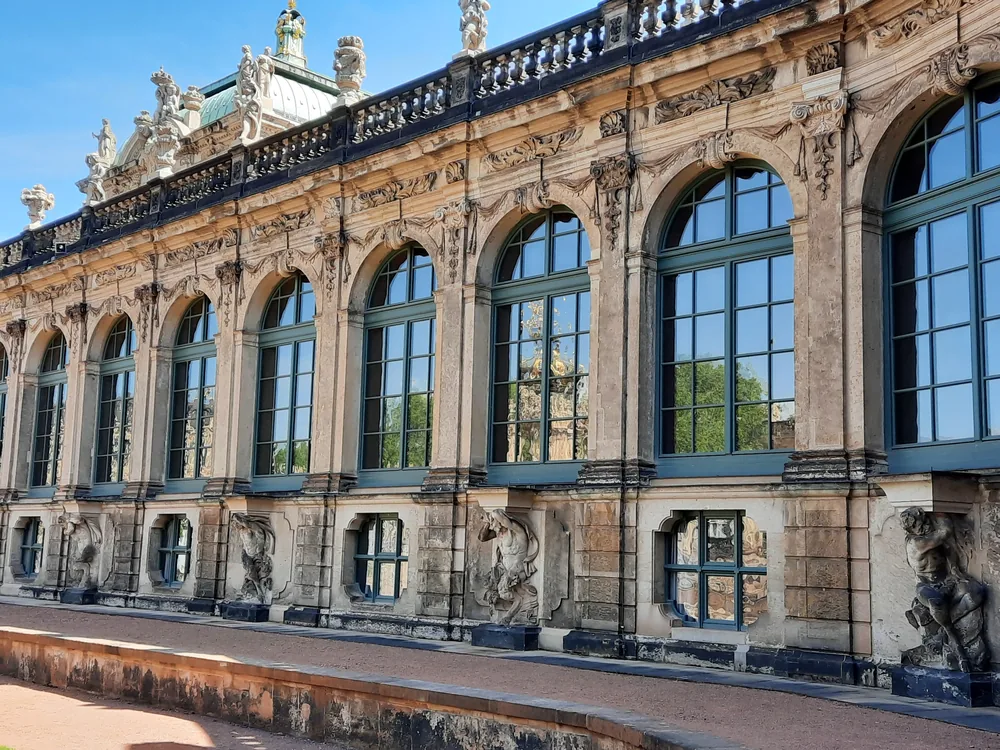
A special field is the conservation of listed buildings. Historic buildings often have rounded bay windows, towers or curved window openings whose original curved panes need to be replaced over time. Curved glass allows glazing appropriate to listed buildings that follows the original shape exactly — today combined with modern properties such as thermal insulation or safety. This preserves the historic character while achieving the comfort of today’s standards.
Design and effect
Curved glass is always also a design statement. A curved glass façade looks dynamic and high-quality, a round display case stages its contents, a curved staircase glazing makes the circulation appear to float. Because curved glass is rarer and more complex, it sets deliberate accents — it is used where form and ambition are meant to be particularly visible.
Design, site measurement and delivery time
As a special component, curved glass requires careful preparation. Shape and radius must be defined exactly, site measurements taken precisely and the installation situation clarified early. Tolerances are tighter and delivery times longer than with flat glass, because each pane is produced over a mould. Subsequent changes are expensive. Early coordination between design, manufacturer and fabricator is therefore the key to success.
Function and energy efficiency
Curved glass must fulfil not only form but also function. As coated insulating glass it provides thermal insulation and solar control, so that curved façades also meet the requirements of the German Building Modernisation Act (GModG, formerly GEG). With toughened panes and a laminated build-up it offers safety and barrier protection, with an acoustic interlayer even sound insulation. The art lies in combining the desired curvature with these functions — because every additional function increases the complexity of production. Early coordination between form, build-up and function prevents requirements from turning out to be incompatible only during production.
Tolerances and quality
Curved glass is less forgiving than flat glass. Because each pane is produced over a mould, dimensional and shape tolerances need closer attention: the curved contour must match the installation situation and — with insulating glass — the second pane. Optical quality also plays a greater role, as reflections on curved surfaces make distortions more visible. High-quality production and a clear specification of the permissible tolerances are therefore decisive for a clean result.
The curved glass façade: free forms in architecture
Curved glass is part of a larger trend: buildings are becoming more sculptural, façades more flowing, interiors more softly structured. Where faceted, straight panes used to approximate curves, a genuine curved glass façade today makes continuous, jointless curvatures possible — as thermally curved insulating glass in curtain walling and unitised façades, or as a cold-bent pane in a system frame. This changes the effect considerably — a curved glass front looks as if it were made in one piece, not assembled. With better production processes and curved functional glass, the scope for design continues to grow.
What does curved glass cost? Prices and cost factors
There is no generally valid price list for curved glass — each pane is a formed part whose price depends on radius, build-up and quantity. Anyone looking for a “price list for curved glass” therefore gets the most honest answer the subject allows here: reliable guide values and the levers that determine the price.
To put the order of magnitude into context (an empirical value from our consulting practice, not a manufacturer price, as of 2026): flat safety glass costs around €50 to €250/m² (toughened glass) or €65 to €285/m² (laminated safety glass). Thermally curved glass — because of mould making, the furnace process and tighter tolerances — is, as a rule of thumb, three to five times the price of comparable flat glass; online configurators for curved single panes already start at around €1,200 to €1,300 per pane, and project-specific special shapes are considerably higher.
| Cost factor | Effect on price |
|---|---|
| Process | Cold bending (where possible) often considerably cheaper than thermal bending |
| Geometry | Cylindrical the cheapest; spherical and conical considerably more expensive |
| Radius | The tighter the radius, the higher the effort and risk of rejects |
| Build-up | Single pane < toughened/laminated safety glass < curved insulating glass |
| Quantity | One-off mould costs are spread — repeated parts noticeably reduce the price per m² |
| Format | Oversizes require special furnaces and special transport |
The most effective price lever lies in the design: realistic radii, identical repeated elements instead of many individual shapes and early clarification of whether cold bending in a system frame is sufficient. For this, we create a neutral list of requirements with which comparable quotes can be obtained — instead of a single manufacturer’s price without a basis for comparison.
Who produces curved glass? Finding and comparing manufacturers
Curved glass is produced by specialised glass bending companies — a small number of firms in Germany and Europe that differ considerably in furnace sizes, feasible radii and toughening and lamination options. Five criteria count for the selection: the firm’s limits for radii and formats, the ability to produce curved toughened/heat-strengthened and laminated safety glass including the necessary verifications, documented reference projects with comparable geometry, a sampling process before series production and reliable statements on tolerances and delivery time.
As consultants independent of manufacturers, we do not give a blanket recommendation but name suitable firms for the specific project — depending on geometry, build-up and verification status. The way there: request consulting or go directly to the directory to find vetted fabricators (German only).
Approvals and verifications
Curved glass needs different verifications from flat building glass. There is no harmonised European product standard for curved glass as a construction product. In Germany, usability is usually verified via a manufacturer-specific national technical approval (abZ), otherwise via a project-related approval (ZiE). Vertical, linearly supported curved glazing is designed to DIN 18008-2; horizontal and point-fixed glazing require a project-related construction technique permit (vBG). For linearly supported curved barrier glazing, impact safety has to be verified via a national test certificate (abP). We check which chain of verification applies to your component before it goes out to tender.
Care and service life
Curved glass is cleaned like flat glass and is similarly durable. With curved insulating glass — as with any multi-pane glass — care for the edge seal applies: an intact edge secures long-term function. Protected glass edges and proper storage of the curved panes until installation prevent damage, which requires particular attention with curved glass because of its shape. Since each curved pane is a one-off, a replacement solution should also be considered from the outset — an exact reproduction needs lead time and is laborious to reconstruct without a documented shape.
Typical design errors
- Radius chosen too tight, so that the build-up cannot be produced.
- Curved insulating glass planned without taking the tight tolerances into account.
- Delivery times underestimated — curved glass is not a stock item.
- Site measurement taken too late or inaccurately, leading to remakes.
Our role
We clarify shape, radius, glass build-up and function early in the design, coordinate feasibility with the manufacturer and support site measurement and tendering — independent of manufacturers and documented. In doing so, we also check whether the desired curvature can be combined with the required functions and a realistic budget, and if necessary propose alternatives that come closer to the same design goal. This turns a curved idea into a precisely manufactured, safe and durable component — without nasty surprises in construction.