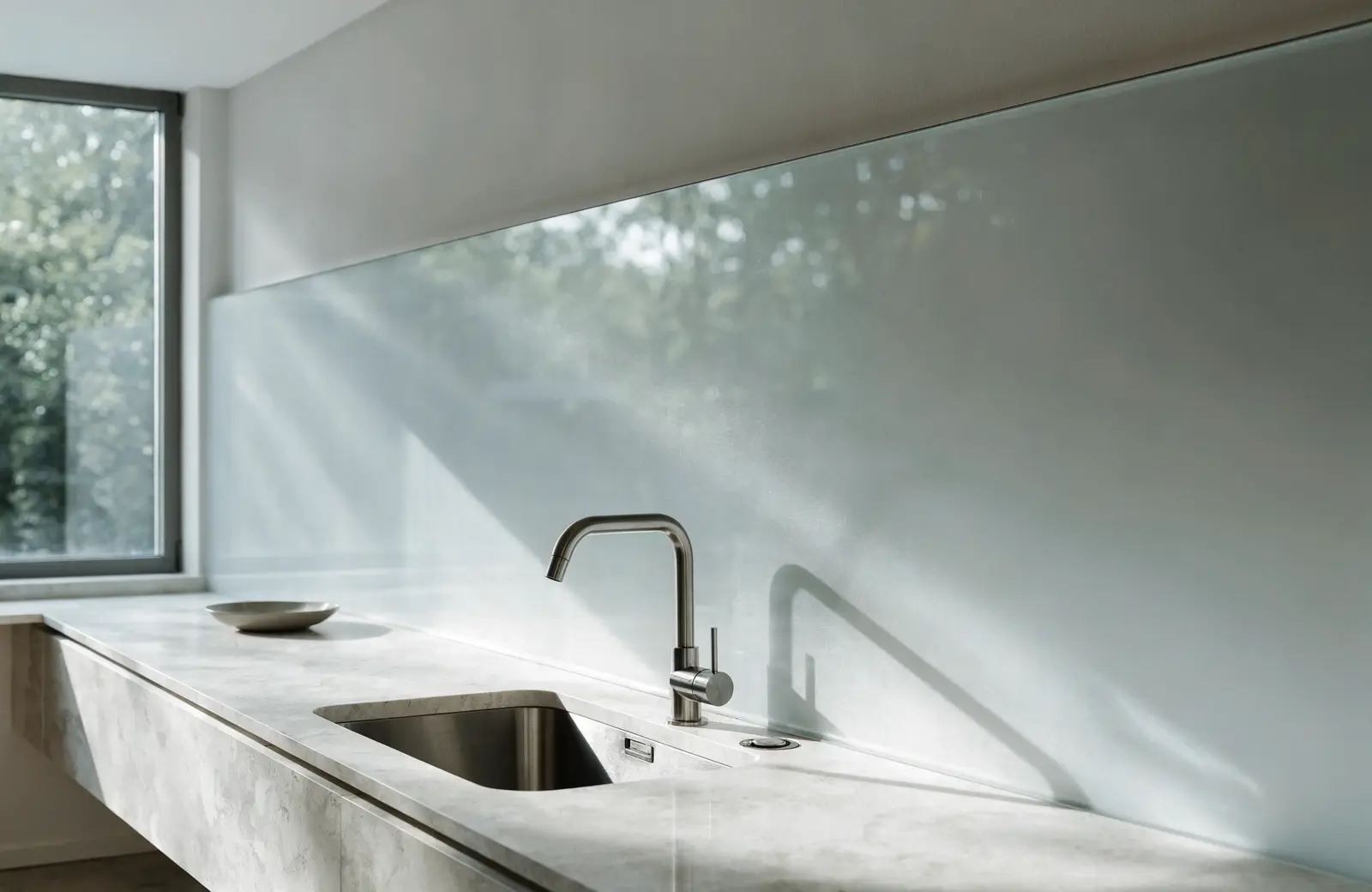
A glass kitchen splashback is an elegant alternative to a tiled wall. As splash protection behind the hob and sink, it protects the wall from grease and water — and at the same time turns a functional surface into a design element. Instead of many joints, the result is a smooth, non-porous surface that is easy to clean.
For kitchen planners, architects and building owners, the glass splashback is attractive because it combines a high-quality look, easy care and design variety. It is made to measure, can be coloured and can visually enhance a kitchen without any tiling or chiselling.
Which glass belongs behind the cooker
Behind the hob, safety counts. This is why toughened safety glass to DIN EN 12150-1 is used. It is thermally toughened and therefore considerably more impact-resistant than ordinary float glass. Above all, it withstands large temperature differences within the pane: up to 200 K according to DIN EN 12150-1, and its mechanical properties remain unchanged at continuous temperatures of up to 250 °C. More on the properties of toughened glass can be found in the GlasWiki under toughened safety glass (German only).
With a gas hob with an open flame, the installation instructions of the hob manufacturer must be observed; we clarify the situation case by case. For pure wall surfaces without heat or impact loads, painted float glass with a safety film can also be sufficient; behind the cooker, toughened glass remains the right choice.
Surfaces and colours
The freedom of design is great. The back of the glass can be painted, glossy or matt. This produces a rich, even surface of colour. According to BF Bulletin 020, however, paint can only withstand limited mechanical and thermal loads; fired enamel on toughened glass is considered mechanically and thermally resistant there.
| Finish | Effect |
|---|---|
| Painted, glossy | Strong colour, plenty of depth |
| Painted, satin-finished | Matt, refined |
| Satin-finished / frosted glass | Bright, diffuse, modern |
| Clear / low-iron glass | Shows the wall behind |
| Digital print | Motif, photo or texture |
A digital print with a motif, photo or texture on the back is also possible. Anyone who particularly likes design will find further finishes in decorative glass (German only) that can be transferred to wall surfaces.
Dimensions, cut-outs and site measurement
A glass splashback is made to measure. Cut-outs and holes for sockets, light switches, taps or wall outlets are incorporated according to site measurements. Important: with toughened glass, all cut-outs, holes and edges must be made before toughening — toughened glass cannot be processed afterwards. This is why precise, careful site measurement is the basis of every successful splashback. Visible edges are ground or polished.
Installation — even over old tiles
The splashback is bonded: with an adhesive that is compatible with the paint finish, in vertical beads on the clean, dry and grease-free substrate. The procedure and quantity follow the manufacturer’s instructions. Alternatively, visible spacers are used.
An advantage in renovation: the splashback can also be bonded onto existing tiles if the substrate is firm, level, clean and dry. It then covers the old surface — without chiselling, dust or building dirt. Heavy or large panes are secured against slipping while the adhesive dries; the surrounding edges can be sealed if necessary.
Care and hygiene
Glass has a smooth, non-porous surface. In the kitchen it is used for its hygiene, ease of cleaning and design variety, especially behind the cooker, where grease and splashes occur.
In the bathroom and on other wall surfaces
Glass is also suitable as wall cladding in the bathroom, for example behind the washbasin or in the shower. There, moisture is what counts: according to BF Bulletin 020, paint is only considered conditionally suitable for wet rooms, while fired enamel is considered suitable for wet rooms. For heavily used or safety-relevant surfaces, we choose the right glass build-up — up to laminated safety glass where fragment retention is required.
Typical design errors
- Measurements taken before base units and worktop were finally installed.
- Cut-outs for sockets forgotten — not possible afterwards with toughened glass.
- Installation instructions of the hob manufacturer not observed with a gas hob.
- Ordinary float glass instead of toughened glass planned behind the hob.
Choosing the right kitchen splashback
The selection starts with the load: behind the hob, i.e. close to a heat source, toughened glass rather than float glass is the right choice; on pure wall surfaces there is more leeway. Then come colour and surface (painted, satin-finished, clear or printed), and finally dimensions, cut-outs and type of installation. Anyone who clarifies these points properly gets a splashback that convinces visually and functionally for years.
Our role
We advise independently of manufacturers on type of glass, thickness, surface and installation, take heat loads and cut-outs into account and ensure clean site measurement. Through our network of fabricators (German only), we put you in touch with the right specialist firm. The result is a kitchen splashback that is hygienic and tailored exactly to your kitchen — without you having to work your way through manufacturers’ product catalogues.