Light in glass combines the material glass with integrated light: LED modules sit in the laminate, or a light source illuminates a translucent pane from behind. Glass itself thus becomes a luminaire or a luminous surface — as a reception counter, as a room-dividing wall, as a ceiling or façade element. The appeal lies in the fact that the technology disappears into the material and seemingly only the light remains.
For architects, planners and building owners, the topic is appealing but demanding: it touches glass construction, lighting technology, electrical design and maintenance at the same time. The following sections explain the common principles, their limits and the questions that should be clarified before making a decision.
Two basic principles: LED in the laminate and backlit glass
Technically, two routes can be distinguished. With LED glass, the light sources are part of the glass build-up. The edge-lit principle is common: LEDs sit in the edge of the pane and shine in via the glass edge. Scattering dots, a translucent interlayer or a structured surface ensure that the light emerges evenly as a surface. Alternatively, light-emitting or translucent films can be laminated directly into the glass.
With backlit glass, by contrast, the light source remains outside the pane. A light box or surface-wide LED backlighting sits behind a translucent, satin-finished or printed glass. This principle is often simpler in terms of construction, because the lighting technology can be separated from the glass and maintained — but it needs installation depth behind the pane.
Technical values for orientation
The exact values depend on the product and manufacturer, but some guide values help with the initial classification of LED/backlit glass:
| Parameter | Guide value (orientation) |
|---|---|
| Installation depth (edge-lit laminate) | approx. 16–22 mm |
| Power consumption | approx. 25 W/m² |
| Luminous flux | approx. 1,800 lm/m² |
| Light colour | 2,700 K (warm) to 6,500 K (daylight white), RGB possible |
| Operating voltage | usually 12 or 24 V DC via transformer, 230 V connection |
| Maximum format (surface) | up to approx. 300 × 120 cm, depending on the system |
Instead of the small installation depth of edge-lit glass, backlit solutions need a cavity behind the pane for the light box and heat dissipation — in return, the lighting technology there is accessible and maintainable.
Translucent effects and design
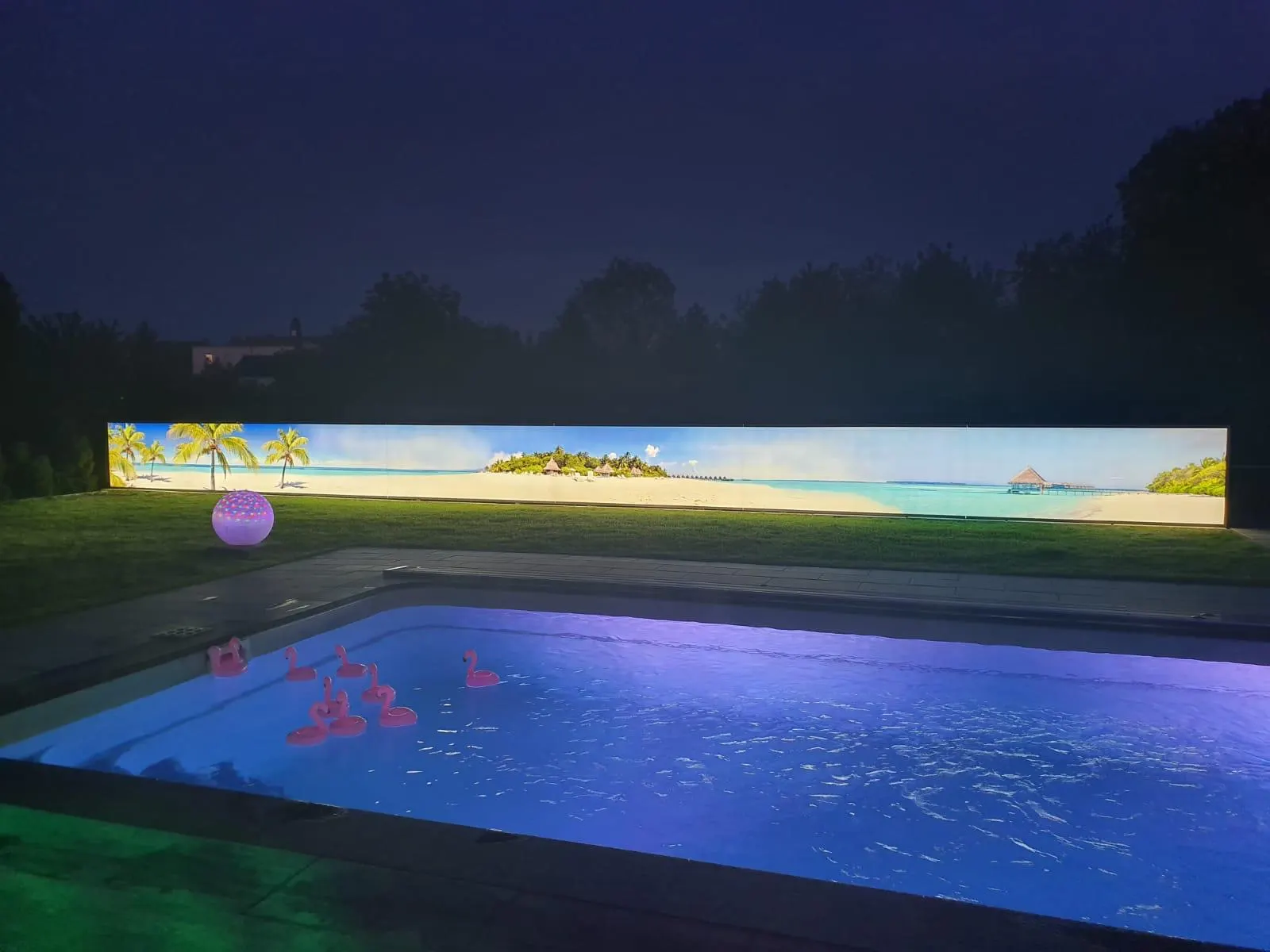
The design spectrum is broad. A clear pane mainly lets the edges and introduced structures light up, while satin-finished or translucent glass produces an evenly shimmering surface. Combined with digital or screen printing, luminous motifs, logos or graphic patterns are created, in which only the translucent areas let light through.
Decorative laminated glass with inserts can also be backlit, so that materials, fabrics or structures stand out three-dimensionally. Related approaches can be found in the field of laminated and decorative glass (German only); an example of a customisable laminated glass with a mineral character is laminated glass with stone (German only), which, depending on the version, can be combined with light effects.
Control and light colour
Light in glass does not have to be static. Depending on the system, the modules are dimmable, adjustable in light colour (tunable white from warm to neutral white) or colour-controllable as an RGB/RGBW version. Control is via control gear (power supplies and controllers) that can be connected via common protocols such as DALI or DMX and thus to a building or lighting control system. For residential and commercial areas, smart home and wireless solutions are increasingly being added — such as Casambi (Bluetooth), ZigBee or integration into KNX — as well as simple wireless remote controls or app control. This allows the light to be integrated into scenes, schedules or home automation.
It is important to clarify these requirements early: where is the control gear located, which cable routes are needed, should the light be controlled by scene or centrally? Control and power supply help determine the wiring effort and should be part of the electrical design, not a later addition.
Build-up, heat and tightness
The structural core lies in the edge of the pane and in heat dissipation. LEDs generate waste heat that must be dissipated so that glass, films and bonded joints remain stable over the service life. The build-up, module output and ventilation should therefore be matched to the place of use. Components embedded in the laminate must also be permanently protected against moisture.
| Feature | LED in the laminate (edge-lit) | Backlit glass |
|---|---|---|
| Light source | integrated in the edge of the pane | separately behind the pane |
| Installation depth | small, flat | larger cavity needed |
| Maintenance of light source | limited access | usually accessible |
| Effect | luminous edges/surface | even light surface |
The table shows typical tendencies — the specific properties depend on the chosen system and manufacturer. Dimensions, permissible formats, connection details and thermal limits are product-specific and must be checked case by case.
Maintenance and service life
LEDs generally have a long service life. What is decisive for practical suitability, however, is the question of replaceability: if the modules are firmly laminated into the laminate, they usually cannot be replaced individually after a defect — in the event of damage, the entire element is replaced. With backlit solutions, the lighting technology is usually accessible and therefore easier to maintain.
When planning, it is therefore worth assessing service life, warranty commitments, the availability of spare parts and the effort of a replacement together — especially in busy or hard-to-reach places.
Applications
Indoors, typical applications are reception and counter surfaces, luminous walls, room dividers, stairs and balustrades as well as ceiling and floor elements. Here it is mostly about atmosphere, brand presence and orientation. The requirements are manageable as long as heat, control and cleaning are considered.
On the façade and outdoors, the requirements rise considerably: weather, temperature changes, tightness of the electrics and — depending on the function of the glass — structural and safety requirements are added. Such applications require a build-up expressly designed for them and close coordination with façade and electrical design.
Illuminated kitchen splashback, bathroom and wet rooms
A growing field of application lies in the residential sector: the illuminated kitchen splashback replaces tiles with a jointless, easy-to-clean and backlit glass surface — often with a motif or colour print. In the bathroom, too, luminous glass walls, backlit mirrors and shower walls are used. In wet rooms, two things are decisive: a suitable, sealed build-up and a professional, protected electrical installation in line with the requirements for wet areas. Glass scores here with hygiene and ease of care — provided the build-up and electrics are designed for the moisture.
Real glass or acrylic panel?
Light surfaces are available in real glass (usually toughened glass) or as acrylic/plastic panels. Real glass is scratch-resistant, high-quality in appearance, resistant to ageing and yellowing and easy to clean — a clear advantage especially on splashbacks and heavily used surfaces. Acrylic is lighter and cheaper, but more sensitive to scratches and more prone to discolouration over time. For durable, prestigious or heavily used applications, toughened glass is generally the better choice.
Glass finishing for light effects
How the light looks depends heavily on the glass surface. Common finishes are satin finishing or matting and frosted glass for an evenly shimmering surface, sandblasting and subsurface laser engraving for three-dimensional structures and engraved motifs that light up, as well as screen and digital printing for logos, photos and graphic patterns in which only the translucent areas let light through. The same technology can thus produce a subtle surface light or a striking motif glass.
Installation and power supply
Installation depends on location and build-up. Depending on the situation, illuminated glass is bonded, set in retaining profiles, point-fixed or fitted in a frame construction; joints are sealed with silicone in wet and outdoor applications. With overhead installation (such as luminous ceiling panels), additional securing of the glass is added. Electrically, a power supply or transformer is needed (LEDs usually run on 12 or 24 V), a planned cable route with an inconspicuous cable outlet and the 230 V connection by a qualified electrician. Electrical design belongs in the plan from the start, so that the transformer and cable routes do not end up visible or inaccessible later.
Costs and price factors
There are no binding flat-rate prices — light in glass is a project-specific special component. The price is determined above all by:
| Cost factor | Influence |
|---|---|
| Area and format | larger = more expensive, special formats extra |
| Technology | Edge-lit laminate more complex than simple backlighting |
| Control | dimmable/RGB/smart home increases electronics and design effort |
| Finishing | Printing, subsurface laser engraving, special decors |
| Place of installation | Wet room, façade and overhead make the build-up more expensive |
Light in glass becomes cost-effective where it combines function and design — orientation, brand presence, atmosphere — rather than serving as pure decoration. We assess the cost drivers before sampling and tendering.
Our role
We advise independently of manufacturers on which principle — LED in the laminate or backlit glass — fits the design wish, installation situation, control and maintenance concept, and critically check build-up, heat dissipation and electrical requirements. On this basis, we put you in touch with the right manufacturer or fabricator from our network and provide support from the idea through sampling to coordination with lighting, electrical and façade design. GlasLotsen does not sell glass; it assesses, checks and creates the basis for a sound decision.